AI and Machine Learning are often wrapped in jargon that makes business leaders feel like they are outsiders in their own data conversations. This post breaks down the buzzwords into plain English, with real-world analogies and examples, so you can confidently join the conversation and spot the opportunities for your business.
A Personal Introduction
Hello again, it’s Grant here. Last week I launched this blog with a simple question: Why does AI matter for data-driven businesses in 2025?
The feedback I got from readers and in a couple of follow-up calls was clear: the biggest barrier to getting started with AI isn’t money or technology. It’s the language. Words like neural networks or unsupervised learning float around and instantly make people feel like they are not technical enough to keep up.
Here’s the truth: you don’t need to be a data scientist to talk about AI. You just need the right mental hooks to understand what’s going on. Think of this post as your cheat sheet - the core terms explained in plain English, with the kind of practical flavour that we like to focus on here at Lakeland Analytics.
Artificial Intelligence vs Machine Learning
Let’s start with the obvious. AI (Artificial Intelligence) is the broad umbrella: software that mimics aspects of human intelligence, like recognising patterns, making predictions, or even generating text and images.
Machine Learning (ML) sits underneath AI. It’s not about hard-coding every decision; it’s about letting algorithms learn from data. The more data you feed them, the better they get.
Analogy: Think of AI as teaching a team of apprentices, while Machine Learning is the actual process of those apprentices learning by doing, improving each week as they see more examples.
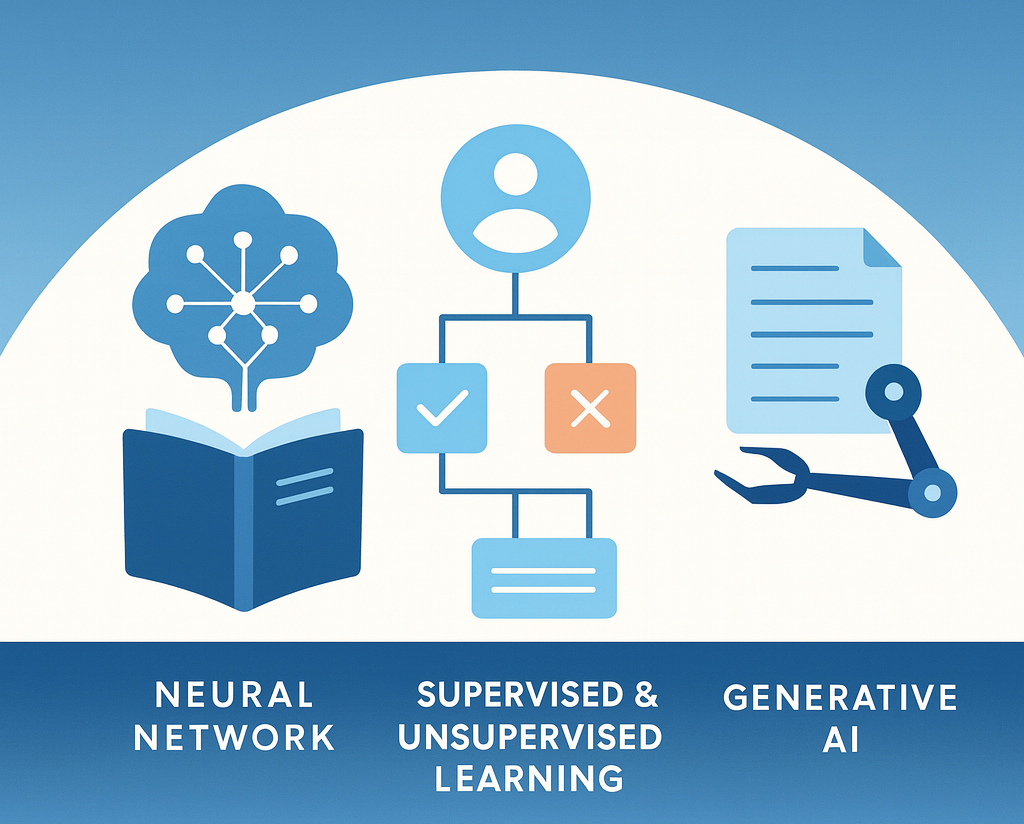
Supervised vs. Unsupervised Learning
This one pops up a lot.
- Supervised learning is when we feed a model with labelled data. For example, we show it thousands of invoices marked “paid” or “unpaid” so it can learn to spot the difference.
- Unsupervised learning is when we give the model unlabelled data and let it group things on its own. For example, clustering customers into groups based on buying habits — even if we didn’t predefine the categories.
Analogy: Supervised learning is like training a new hire by showing them old files that were already stamped “approved” or “rejected.” Unsupervised learning is like dropping them into a room of paperwork and asking them to organise it however they see patterns.
In business terms:
- Supervised is great for prediction (e.g., will this invoice be late?).
- Unsupervised is great for discovery (e.g., which customers behave alike?).
In our work we sometimes use a combination of both. For example, we might use supervised learning to build a model that can predict late payments, and then use unsupervised learning to cluster customers into groups based on their payment history. Even by factors that we may not have considered, they could be the reason why you are being paid late or early.

Neural Networks.
Neural Networks
Here’s the buzzword that makes everyone’s eyes glaze over.
A neural network is just a fancy way of describing an algorithm designed to mimic how the human brain works: lots of little “nodes” (like brain cells) that pass signals to each other.
Analogy: Imagine a giant decision-making flowchart, but instead of one rigid path, there are thousands of little “mini-judges” passing their opinions along until the network reaches a conclusion.
You don’t need to know how the wiring works. What matters for leaders is that neural networks are behind today’s big leaps: image recognition, voice assistants, and even commonly used tools like ChatGPT and Microsoft's Copilot.
Their strength lies in spotting patterns across massive amounts of data that no human could ever process, making them powerful engines for predictions and decisions.
We like them because they think and act like us!
Generative AI
This is the hot one. Generative AI refers to AI models that can create new content - text, images, audio, even video based on the patterns they’ve learned.
Analogy: Think of it like a new member of staff who’s read absolutely everything that your company ever published, plus half of the internet. Now they can draft a report, design a concept sketch, or brainstorm product names at the drop of a hat.
The power of this for our businesses is obvious... content generation, customer service chatbots, rapid prototyping, and creative support. But there’s a catch! This member of staff, just like any other member of staff, can sometimes be overconfident and wrong.
I guess this raises the point of where we find ourselves right now - we are in the early days of the AI revolution, and there is a lot of hype and confusion around it. The truth is that AI is already changing the way we work, and it is only going to improve and accelerate... but a degree of human oversight is not just necessary, it is essential.
Data, the Unsung Hero
Every one of these terms links back to a common foundation: data.
- Good data = fantastic insights 🥰
- Messy data = absolute chaos on autopilot 🤯
I’ve seen many examples of this firsthand. Imagine a finance team that wants to use Machine Learning to flag duplicate invoices automatically. A brilliant idea, but their master data is inconsistent - the same supplier listed three different ways, “Ltd” in one, “Limited” in another, and “LTD” in a third. The result? The model may flag many false positives or even miss genuine duplicates - meaning that it cannot be relied upon to make decisions.
Over the years we have been commissioned by a number of organisations to carry out data cleansing exercises. It doesn't need to be complex, but even a simple exercise to clean a customer table can make a huge difference to the end result. The above example would switch from being little more than an unreliable 'noise generator', to a valuable company asset. You will find this to be a recurring theme with AI: get your data house in order, and the possibilities are endless.

The knowledge and curiosity to ask the right questions.
Why Business Leaders Should Care About the Jargon
Here’s the point: when you understand the language, you unlock the ability to ask the right questions.
Instead of feeling lost in a vendor pitch, you can say:
- “Are you using supervised or unsupervised learning here?”
- “How much training data does this model need?”
- “What’s our process for cleaning and labelling that data?”
Those aren’t technical questions; they’re leadership questions. And they show that you’re steering the ship, not just being sold a shiny tool.
Busting the “Too Technical” Myth
One of my favourite moments in this space came from a conversation with the General Manager of a large site. He said: “Grant, I’m not technical, so I’ll leave this to the IT guys.”
I get that a lot - and it always makes me smile. Because the truth is, you don’t need to be technical to start making the most of AI and Machine Learning. What you really need is a willingness to be curious and to keep asking questions that shine a light on the problems worth solving. In my experience, the best ideas don’t come from the IT department alone, they come from the people who know the day-to-day challenges, the inefficiencies, and the opportunities that are hiding in plain sight. When leaders and managers give themselves permission to ask “what if” or “why not,” they often unlock far more value than they realise. What you really need is the curiosity to ask the right questions.
Questions like:
- “What could we do if we could spot problems before they cause us pain?”
- “Where are we losing the most time in our processes?”
- “Which decisions take us the longest, and could AI help us to speed them up?”
- “Could AI enable us to focus on the right things instead of feeling like busy fools?”
The people closest to the work - whether that’s managing facilities, reviewing invoices, or leading a team - often know exactly where the biggest headaches and opportunities lie. That’s the fuel that your AI transformation needs.
You don’t need to understand the algorithms or the maths. You just need to know the outcomes that you care about. AI is just a tool to help you get there faster, cheaper, and with fewer surprises along the way.
Wrapping Up: A Jargon-Free Future
Well week 1 was about why AI matters, week 2 has been about speaking the language. My hope is that the next time you hear someone using terms like “supervised learning” or “neural network,” you won’t switch off, you’ll be able to lean in, knowing that you’ve got some tools with which to engage. If there are other terms or concepts that you would like me to try and demystify, drop me a message - I’d love to hear what’s on your mind.
Next week, we’ll zoom out again and look at the top AI trends shaping data analytics in 2025 and likely into 2026. From Predictive AI to AI-Driven Automation, I’ll cover what’s hype, what’s here to stay, and what it means for industries like Facilities Management, Manufacturing and Finance.
Until then, remember: AI isn’t magic. It’s just data, structured in smarter ways. And the language? Now you speak it.
Grant 🫡